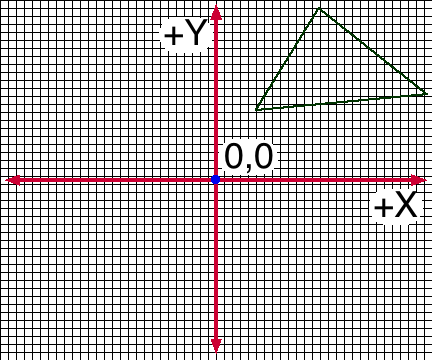
A coordinate system is needed for measuring objects' positions
It allows us to describe any location by a set of numbers - 2 numbers when working in 2 dimensions, 3 numbers for 3 dimensions.
A coordinate system has an origin (a reference point) and coordinate axes
In 2D we have an X axis and a Y axis. In 3D, we add a Z axis.
The axes are perpendicular - they are independent
OpenGL's default 2D coordinate system has the window cover the
area from -1 to +1 in X and -1 to +1 in Y.
(0,0) is at the center of the window.
This can be changed with the function gluOrtho2D
e.g.:
	glMatrixMode(GL_PROJECTION)
	glLoadIdentity()
	gluOrtho2D(0.0, 10.0, 0.0, 5.0)
GLUT's reshape callback is a common place to use
gluOrtho2D.
It's called whenever the window changes size.
e.g., to make the window always span -10 to +10 in X, and keep the aspect ratio 1:1,
def reshape(w, h):
	glViewport(0, 0, w, h)
	glMatrixMode(GL_PROJECTION)
	glLoadIdentity()
	gluOrtho2D(-10, 10, -10*h/w, 10*h/w)
	glMatrixMode(GL_MODELVIEW)